GuidesQR-bills and contributions
The class fund: what parents can be asked to pay
In Switzerland, public basic education is free, and the Federal Supreme Court has already said what that means for school trips and camps. Here you see what can be asked of families, how a voluntary fund works, the school year and the accounts to show at the end.
Only for people who live in Switzerland.For information. This guide follows Swiss law and Swiss rules. It may contain errors or be out of date: always check the official sources and, if in doubt, ask an official service for help. Not financial, tax or legal advice; for fees and e-banking features, your bank's information applies.
- Education is free
- What you can ask for
- The school camp
- The voluntary fund
- The school year
- The fund's accounts
- Before asking for money
- The class fund with QR Quota
- Questions
Basic education is free: what that means
In Switzerland, every child has the right to sufficient basic education, free of charge (art. 19 Cst.). The cantons guarantee it: basic education is compulsory and, in public schools, free (art. 62 Cst., para. 2). Whoever collects money for the class needs to know where what the school pays for ends and where what can be asked of parents begins.
The Federal Supreme Court has already ruled on school trips and camps. In the judgment ATF 144 I 1 (7 December 2017, in German), it held that compulsory trips and camps are part of free education. Parents can only be asked for the costs they save because their child is away: food. According to the court, between CHF 10 and 16 a day, depending on age.
TeachingThe lessons and whatever is part of compulsory schoolingTripsThe compulsory ones, the transport and the activityCampsThe compulsory school ones, except the food costs savedMaterialsWhat is needed for lessons: a cantonal rule, check with the school
FoodAt a compulsory camp, only what parents save at homeVoluntaryParties, gifts, outings outside school hours and other non-compulsory activities
Who decides what is compulsory. The school does, not the class fund. If you are unsure about an expense, ask the school management or the teacher before you ask the families for it.
Can parents be asked to pay this expense?
Answer two questions about the expense you have in hand.
1. Is the activity part of the school programme and compulsory for all pupils in the class (a trip, a school camp)?
Yes No2. Is it material needed for lessons (exercise books, books, tools the teacher requires)?
Yes No: it is a gift, a party or an outing outside school hoursIt is part of free education (art. 19 Cst.). Parents can only be asked for the food costs they save because their child is away: according to the Federal Supreme Court, between CHF 10 and 16 a day, depending on age. The school or the municipality pays the rest. A child whose family does not pay for food is not left out.
Material needed for lessons is part of free education. But the rule is set by the canton: check with the school what it provides and what it asks the families for.
A non-compulsory activity can cost more. But paying is voluntary: say so clearly, ask for a small amount and do not leave anyone out for not contributing.
How much can be asked for a compulsory school camp?
Enter the camp's figures. The amount per day lies between CHF 10 and 16, the limits the Federal Supreme Court mentions; change it to see the difference.
The maximum for parents
- At most, per pupil
- Whole class
- The school or the municipality pays the rest
The court spoke of CHF 10 to 16 a day, depending on age. Outside this range, check the amount with the school.
What you ask of parents is more than the total cost of the camp. Check the figures.
An example. The school sets the amount, and the class fund is not part of this calculation. The school can ask parents for less than the maximum.
The voluntary fund: how much to ask each family
For the extras (a gift, a get-together, a party), many classes run a fund: each family gives, if it wants to, a small amount. Plan first what will be spent. Then you see how much each family would have to give.
The year's fund
- Goes into the fund
- Planned expenses
- Left over (or short)
- Amount that would cover everything
of the families contribute. There is missing: spend less, rather than asking more of those who have already given.
A group gift is split among those who want to take part. Here, six families chip in for a gift of CHF 100. The shares are equal and the split is exact to the cent: nobody pays more than the others.
| Family | Weight | Share (CHF) |
|---|---|---|
| Family 1 | 1 | 16.67 |
| Family 2 | 1 | 16.67 |
| Family 3 | 1 | 16.67 |
| Family 4 | 1 | 16.67 |
| Family 5 | 1 | 16.66 |
| Family 6 | 1 | 16.66 |
Whoever can't, doesn't have to explain. Tell everyone that contributing is voluntary and that nobody has to give reasons. Never talk about who has paid or not in front of other families.
The fund's school year, from August to July
An example calendar. The exact dates depend on the school and on your class.
- Parents' meetingYou agree on the amount, what the fund pays for and who the contact person is
- Collecting the fundEach family gives, if it wants to, the agreed amount
- ChristmasThe get-together and the teacher's gift
- School campIf it is compulsory, the school charges only for food
- End-of-year party and giftVoluntary, like the rest of the fund
- ReportingOne page for all families, with the balance
The parents' meeting is the best moment. Saying right at the start what the fund pays for, how much is asked and that it is voluntary avoids misunderstandings later.
The fund's accounts, in an example
A class of 22 families. The figures are invented, but the shape is that of many class funds: where the money came from, where it went, and the balance. Note that only 17 families gave the CHF 20 contribution: the fund lives with that.
Where the money came from: CHF 460
| Income | CHF |
|---|---|
| Contributions (17 of 22 families) | 340 |
| Cakes sold at the party | 120 |
Where it went: planned and actual
| Expense | Planned | Actual |
|---|---|---|
| Christmas get-together | 120 | 100 |
| Christmas gift | 60 | 60 |
| End-of-year party | 150 | 160 |
| End-of-year gift | 80 | 70 |
| Supplies and sundries | 30 | 20 |
CHF 410 was spent, less than the CHF 440 planned. What is left stays in the fund for next year, or is given back: decide with the parents.
Keep the receipt (or a photo of the slip) for every payment out. Keep the fund in an account used only for it, separate from your own money; check with the school and with your bank how to open one. At the end of the year, show everyone the accounts on one page: how much came in, how much went out, what is left. No names of who gave.
Before asking parents for money
A list to tick off as you go. It is stored only in this browser.
- It is stated that it is voluntary. In the email, in the group message and at the parents' meeting.
- The amount is small. An amount any family can give without a second thought.
- Nobody is left out. No child misses an activity, a party or a gift because the family did not give.
- There is a single contact person. Whoever asks knows who to write to.
- Every expense has a receipt. Invoice, slip or photo.
- There is an account just for the fund. The money is not mixed with yours.
- The accounts go to everyone at the end of the year. One page, no names.
- The school knows about the fund. Especially if an expense looks like something in the school programme.
Subject: Class fund – school year [20XX/XX]
Dear parents, for the extras of the year (the Christmas get-together, the gifts and the end-of-year party) there is a class fund. Contributing is voluntary. If you wish, you can give CHF [amount]; if you can't or would rather not, there is no need to say anything, and your child takes part in everything like the others. At the end of the year, I will show everyone the accounts. Thank you, [Your name]
The class fund with QR Quota
- The families, onceName and email of each one
- The same amount, or an expense to splitThe fund contribution, equal for everyone
- One QR-bill per familyEach with its own reference
- Who has paidYou mark it; you resend only to those who haven't
That is what QR Quota is for, an app for iPhone. The class is the group, the families are the members. You can ask everyone for the same amount, or split an expense (a gift, a party) among the families who want to take part. Paying stays voluntary: say so in the email that goes with each QR-bill and in your message.
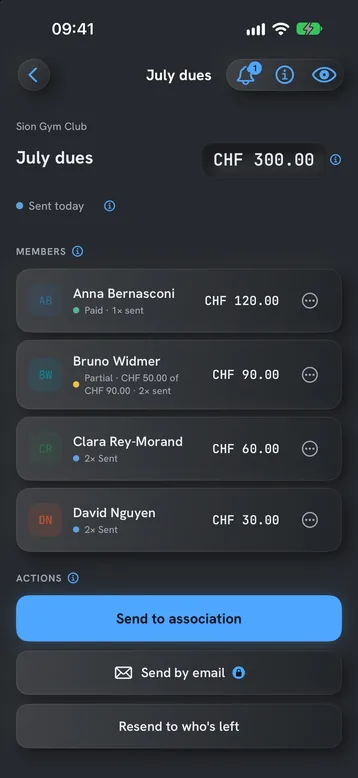
- The fund contribution or an expense to splitThe same amount for each family, or a total divided by weights.
- Every year, on timeThe app prepares the next send. Nothing goes out without you, unless you turn on automatic sending (Pro).
- One reference per family and per sendSCOR with a regular IBAN; QRR with a QR-IBAN. It follows the Swiss Payment Standards (IG v2.3).
- From your emailThe app sends from your account, Gmail or another provider.
- The data stays on the iPhoneNo account. The app does not talk to your bank: you mark who has paid.
Free for one association with up to two members and three active expense reports, no time limit. A class has more families: you can try Pro free for 14 days; then you choose weekly, yearly or a one-time payment, for life. The price is in the App Store.

Download QR Quota for iPhone. One QR-bill per person, each with its own reference, sent from your own email. Free to start, no account.

Frequently asked questions
Is education in Swiss public schools free?
Yes. Every child has the right to sufficient basic education, free of charge (art. 19 Cst.). The cantons guarantee basic education that is compulsory and, in public schools, free (art. 62 Cst.).
Do parents have to pay for school trips and camps?
If they are compulsory, they are part of free education: according to the Federal Supreme Court (ATF 144 I 1), parents can only be asked for the food costs they save because their child is away. Non-compulsory activities can cost more.
How much can parents be asked to pay for a school camp?
Only the food costs saved. According to the Federal Supreme Court (ATF 144 I 1), between CHF 10 and 16 a day, depending on age. The school or the municipality pays the rest. Check the amount with the school.
Is the class fund compulsory?
No. What is part of compulsory schooling is free (art. 19 Cst.). The fund is for extras, such as gifts and parties, and contributing is voluntary. Check the rules of the school, the municipality and the canton.
Can a child be left out because the parents don't pay?
In a compulsory activity, no: it is part of free education (art. 19 Cst.). In a voluntary activity, the rules are those of the school and the canton. In any case, a child's participation should not depend on the family's money.
How do you report on a class fund's accounts?
The law does not set a form. Good practice is to keep the receipt for each payment, have an account just for the fund, and show everyone the accounts at the end of the year, without the names of who gave.
About this guide. Informational content. Not legal or financial advice: what applies to your class are the rules of the school, the municipality and the canton, which vary. The examples and the figures in the accounts are invented. The articles cited are from the Swiss Federal Constitution (Cst.); each one links to the text on Fedlex, in an unofficial English translation (the official texts are in German, French and Italian). The Federal Supreme Court judgment is in German. This guide may contain errors or be out of date: always check the official sources. Updated in October 2026.
Sources (4)
- Fedlex: Federal Constitution, article 19 (the right to free basic education), unofficial English translation
- Fedlex: Federal Constitution, article 62 (schools), unofficial English translation
- Federal Supreme Court: ATF 144 I 1, of 7.12.2017 (compulsory camps and trips), in German
- SIX: Swiss Implementation Guidelines for the QR-bill, version 2.3 (PDF, in English)