GuidesQR-bills and contributions
The budget of a holiday or scout camp in Switzerland: from the cost to the price per child
A holiday camp run by an association starts with a budget. Here you see the lines of a seven-day camp, how to reach the price per child with subsidies, a reserve and a sibling discount, a solidarity price, the calendar, the deposit and the balance, cancellations and the accounts at the end.
Only for people who live in Switzerland.For information. This guide follows Swiss law and Swiss rules. It may contain errors or be out of date: always check the official sources and, if in doubt, ask an official service for help. Not financial, tax or legal advice; for fees and e-banking features, your bank's information applies.
- The camp budget
- The price per child
- A solidarity price
- The camp calendar
- Deposit, balance and cancellations
- The accounts and the surplus
- Billing the families, all at once
- Questions
The budget of a holiday camp, line by line
Scouts, a club, a parish, a youth association: the holiday camp starts on a sheet of paper, before there is a single registration. That sheet holds everything the camp will cost. Who approves the budget, the committee or the general meeting, is set by the statutes; the committee is the body that manages and represents the association (art. 69). Here, an invented camp: seven days, 30 children.
Camp budget: CHF 8’925
| Line | Budget |
|---|---|
| Accommodation | 3’000 |
| Food | 2’600 |
| Transport | 1’200 |
| Activities | 900 |
| Materials | 500 |
| Insurance | 300 |
| Reserve (5%) | 425 |
The reserve is a percentage of the rest of the budget: here, 5% of CHF 8’500. It is there for the unexpected and for the odd cancellation.
That is the cost per child, not the price. The price comes from the next section: take off the subsidies and allow for the discounts.
Camp leaders eat and sleep too. Put the food, the accommodation and the insurance of the people who look after the children in the budget. It is the line most often forgotten.
A compulsory school camp? That has its own rules: basic education in public schools is free (art. 62 Cst., para. 2). It is in the guide The class fund. This guide is for an association's camps.
The price per child: from the cost to what each family pays
The price starts from the total cost, with the reserve. Take off the subsidies and divide the rest by the number of children. If there is a sibling discount, the other children pay a little more, so that the total adds up. Type in your own numbers.
Price per child calculator
- Cost with the reserve
- To be paid by the families
- Price per child
- Price of the 2nd child and following
- Total paid by the families
- Left over, from rounding up
The subsidies cover of the cost. Prices are rounded up to whole francs.
The expected subsidies cover the whole cost and the families would pay nothing. Check whether each subsidy has a cap per child and what it says about any surplus.
If children drop out and the costs do not go down (accommodation and transport usually stay), the reserve and the surplus are not enough: CHF would be missing.
The reserve and the surplus cover the cancellations you entered.
Subsidies: only the confirmed ones. J+S (Jugend+Sport, “Youth+Sport”) is the federal programme that supports activities for young people run by J+S-trained leaders, through the cantons. How much, and on what terms: check with the cantonal J+S office. The municipality, the church or a sponsor have their own rules. Count only what you already have in writing.
A solidarity price, if the association wants one
Not every family can pay the same. One way is the solidarity price: the sum to be covered stays the same, but each family chooses a tier. A tier is a level: low, medium or high. Whoever chooses the high one pays more and helps the low one pay less. It is optional, and it is the association that decides whether the camp has one.
Solidarity price: an example with six families
| Family | Tier | Pays (50% equal) |
|---|---|---|
| Family A, low tier | 1 | 300.00 |
| Family B, low tier | 1 | 300.00 |
| Family C, medium tier | 2 | 400.00 |
| Family D, medium tier | 2 | 400.00 |
| Family E, high tier | 3 | 500.00 |
| Family F, high tier | 3 | 500.00 |
Move the slider. At 100% equal share, everyone pays the same, CHF 400. At 0%, the price follows only the tier. In between, one part is shared by all and the other depends on the tier.
- DiscreetOnly the person doing the accounts knows the tier. Each family gets its own bill, with its own amount, and does not see the others.
- Declared by the familyThe association decides whether to ask for any proof. Write the rule in the registration conditions.
- It only works if the total adds upIf few families choose the high tier, the sum falls short. Do the sums with what you expect, not with what you hope for.
The camp calendar, from the subsidy request to the accounts
An example for a camp in July. The right dates are your own. For the deadlines of each subsidy, check with the cantonal J+S office and the municipality.
- Budget and subsidiesThe written budget and the subsidy requests, with the deadline of each
- BookingsThe house or the site and the transport, with their cancellation terms
- Registration conditionsPrice, deposit, deadlines and refunds, written before opening
- Registrations and depositEach family accepts the conditions and pays the deposit
- The balancePayment of what is left, before the camp
- The campReceipts for everything paid on the spot
- The accountsReal income and expenses next to the budget
- ReportFor those who gave subsidies, with whatever each one asks for
Before opening registrations, a list to tick off as you go. It is saved only in this browser.
- The budget is written and approved. By the committee or the general meeting, as the statutes say.
- The price includes the reserve. And the sibling discount, if there is one.
- The subsidies counted are confirmed. In writing, by whoever gives them.
- The registration conditions are written. Deposit, deadline for the balance, refunds, medical certificate.
- There is a number of places and a deadline. And a waiting list, if you want one.
- The insurance has been checked. Children and camp leaders: check what it covers with the insurer.
- There is an association account to receive payments. With an IBAN, so that families can pay with a QR-bill.
- You ask only for the health data you need. Allergies, medicines, and you keep everything in one place.
Deposit, balance and cancellations
A camp can be paid for in two instalments. The deposit is an advance: a part of the price, paid on registering, that holds the place. The balance is paid later, before the camp.
- The conditionsThe family reads and accepts the price, the deposit and the cancellation rules.
- The depositA part of the price, with a deadline. Once it arrives, the place is theirs.
- The balanceOn a fixed date, a few weeks before the camp.
- The confirmationWhoever has paid in full receives the confirmation and the packing list.
And if a child drops out? Answer the questions.
If you wrote “full refund until such a date”, everything is refunded. If the deposit is non-refundable, it stays out, and the family knew that when it accepted.
If they mention it, apply what is written. If they do not, the committee decides, writes the decision down and treats all families the same way.
With the place filled, the camp does not lose that child’s price. Even so, it is the committee that decides and writes the criterion.
If you wrote that from a certain date there is no refund, that is what the family accepted. If nothing is written, the committee decides; if in doubt, ask a lawyer for an opinion.
In case of a cancellation, what counts is what is in the registration conditions the families accepted. One page is enough: the price, the deposit and the date of the balance, the cancellation deadline, what is refunded, what happens with a medical certificate. Deciding case by case, with the camp already starting, is worse for everyone.
The camp accounts and what to do with the surplus
When the camp ends, the real accounts go next to the budget. The same camp, with invented numbers: where the money came from.
Where the money came from: CHF 9’380
| Income | CHF |
|---|---|
| Families (registrations) | 7’430 |
| Subsidies (J+S, municipality, church) | 1’500 |
| Fundraising party | 450 |
Food cost more than planned and the reserve was hardly used. CHF 640 was left over. And now?
The association decides. Some options: keep it for next year’s camp, lower the price of the next camp, give a part back to the families, use it for another activity. If the statutes do not say who decides, the general meeting decides whatever is not for another body (art. 65). Write the decision in the minutes. And see what each subsidy says about the surplus: some have conditions.
For the debts of the association its own assets answer, unless the statutes say otherwise (art. 75a). That is why the reserve and the cancellation conditions matter. Talk to the committee before the camp starts, not after.
The committee keeps the association’s books (art. 69a). An association that does not have to register in the commercial register keeps simple bookkeeping (art. 957 CO). The books and the supporting documents are kept for ten years (art. 958f CO). The camp receipts go into the accounts of the year and, if needed, to whoever gave subsidies.
And tax? For the direct federal tax, a profit below CHF 5’000 is not taxed (art. 71 DBG). With ideal purposes, up to CHF 20’000, if the whole profit is used for those purposes (art. 66a DBG). The canton and the municipality have their own rules: check with the tax authority.
Billing the families, all at once
- The registered familiesName and email of whoever pays
- Each one’s priceEqual, or by weights
- One QR-bill per familyEach with its own reference
- Who has paidYou mark it; you resend only to those who haven’t
That is what QR Quota is for, an app for iPhone. The registered families are the members of the group. The deposit and the balance are two sends, each with its own QR-bill per family.
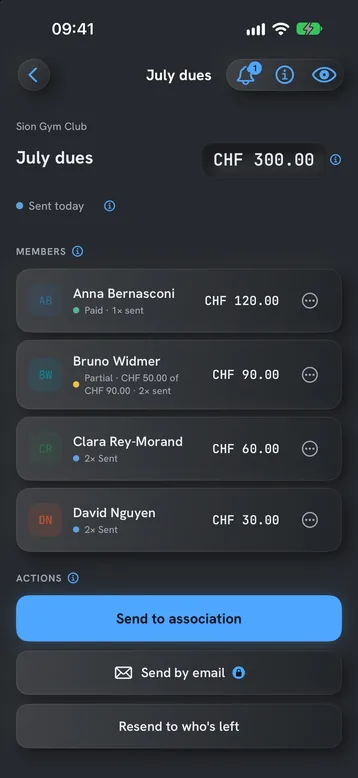
- The sibling discount, by weightsYou give each family a weight: 100 per child, 90 per sibling with a 10% discount. A family with two children: 190. The total is divided to the cent. The solidarity tier works the same way.
- Deposit and balanceEach is a send, on its own date. After the 1st send, the lines are locked. Nothing goes out without you, unless you turn on automatic sending (Pro).
- One reference per family and per sendSCOR with a regular IBAN; QRR with a QR-IBAN. It follows the Swiss Payment Standards (IG v2.3).
- From your emailThe app sends from your account, Gmail or another provider.
- The data stays on the iPhoneNo account. The app does not talk to your bank: you mark who has paid.
The free plan is enough to try it with two families. For the whole camp you need Pro, which you can try free for 14 days.
Free for one association with up to two members and three active expense reports, no time limit. You can try Pro free for 14 days; then you choose weekly, yearly or a one-time payment, for life. The price is in the App Store.

Download QR Quota for iPhone. One QR-bill per person, each with its own reference, sent from your own email. Free to start, no account.

Frequently asked questions
How do you work out the price of a holiday camp per child?
Add up the cost of the camp with a reserve, take off the confirmed subsidies and divide the rest by the number of children. Round up. With a sibling discount, the other children pay a little more, so that the total adds up.
Does J+S pay for a holiday camp?
J+S (Jugend+Sport) supports activities for young people run by J+S-trained leaders, with federal subsidies requested through the canton. The amounts and the conditions vary: check with the cantonal J+S office.
Can I charge less to families with a lower income?
The association decides. One way is the solidarity price: the sum to be covered is the same, but each family chooses a tier, and whoever chooses the high one helps whoever chooses the low one. It is optional, and only the person doing the accounts knows the tier.
Is the money refunded if a child drops out of the camp?
It depends on the registration conditions the family accepted: deadline, deposit, medical certificate. Write them before opening registrations. If nothing is written, the committee decides and treats all families the same way.
What is done with the money left over from a camp?
The association decides: keep it for next year, lower the price, give a part back or use it for another activity. If the statutes do not say who decides, the general meeting decides whatever is not for another body (art. 65). See what each subsidy says about the surplus.
About this guide. Informational content. Not legal, accounting or tax advice: what applies to your camp is the statutes of the association, the registration conditions the families accept and the rules of each subsidy. The examples and the camp figures are invented. The articles cited are from the Swiss Civil Code, the Code of Obligations (CO), the Federal Constitution (Cst.) and the Federal Act on Direct Federal Taxation (DBG); each one links to the text on Fedlex, in unofficial English translation (the official texts are in German, French and Italian). This guide may contain errors or be out of date: always check the official sources. Updated in October 2026.
Sources (4)
- Fedlex: Swiss Civil Code, articles 60 to 79 (associations), unofficial English translation
- Fedlex: Code of Obligations, articles 957 to 958f (accounting), unofficial English translation
- Fedlex: Federal Act on Direct Federal Taxation (DBG), articles 66, 66a and 71, unofficial English translation
- Fedlex: Federal Constitution, article 62 (basic education), unofficial English translation