GuidesQR-bills and contributions
Association treasurer: the year of accounts, from the first payment to the general meeting
In Switzerland, the committee keeps the association's books and almost always hands them to a treasurer. Here you see which bookkeeping the law asks for, the treasurer's year month by month, the membership fees, the accounts that go to the general meeting, the year-end closing and what federal tax says.
Only for people who live in Switzerland.For information. This guide follows Swiss law and Swiss rules. It may contain errors or be out of date: always check the official sources and, if in doubt, ask an official service for help. Not financial, tax or legal advice; for fees and e-banking features, your bank's information applies.
- What the treasurer does
- Which bookkeeping
- The treasurer's year
- Membership fees
- The year's accounts
- Year-end closing, step by step
- What about taxes?
- Questions
What does the treasurer of an association do?
The law does not mention the treasurer. It says that the committee keeps the association's books (art. 69a). In practice, the committee hands that task to one person: the treasurer. What that person does, and how far they can pay out on their own, is set by the statutes and the committee.
Art. 69aThe committee keeps the books; the accounting rules of the Code of Obligations apply by analogyArt. 957An association that does not have to register in the commercial register keeps simple bookkeepingArt. 958fThe books and the supporting documents are kept for ten yearsArt. 69bWho checks the accounts: in most associations, the statutes and the general meeting decide
ReceiveFees, registrations, donations, grantsPayInvoices, refunds, the rent for the hallRecordEvery income and every expense, with the supporting documentReportTo the committee during the year; to the general meeting at the end
Two signatures. Many associations ask for two people to approve payments above a set amount. It protects the association and it protects you. If the statutes say nothing, the committee can decide and write it in the minutes.
Which bookkeeping does your association have to keep?
Most associations keep simple bookkeeping: the income, the expenses and, at the end of the year, what the association has and what it owes (art. 957 CO). Full bookkeeping, with a balance sheet and a profit and loss account, is only compulsory for those that have to register in the commercial register (art. 61). Answer three questions:
1. To achieve its purpose, does the association run a commercial business, such as a shop, a restaurant or a company?
No Yes2. Does the association have to have its accounts audited by an audit body? That happens when, in two consecutive years, it exceeds two of these three limits: CHF 10 million of balance sheet total, CHF 20 million of revenue, 50 full-time jobs (art. 69b).
No Yes3. Is the association's main activity collecting or distributing money abroad, for charitable, religious, cultural, educational or social purposes?
No YesA list of the income and the expenses, with the supporting documents, is enough, plus what the association has and owes at the end of the year: bank, cash, debts (art. 957 CO). Even if the association is registered in the commercial register of its own choice.
The principles of proper bookkeeping still apply: everything recorded, complete, verifiable.
The association has to register in the commercial register (art. 61) and keep the full bookkeeping of the Code of Obligations, with a balance sheet and a profit and loss account (art. 957 CO). Here, talk to an accountant.
On question 3, the Federal Council can exempt low-risk associations from registration.
This is the sum the treasurer has to close every year. If the calculated balance is not equal to the bank plus the cash, a transaction is missing.
The treasurer's year, month by month
An example for an association whose financial year is the calendar year. The right dates are the ones in your statutes.
- Year-end closingStatement as at 31 December, cash counted, amounts to collect and to pay
- Checking the accountsThe auditors (account checkers) go through the books and write their report
- General meetingApproves the accounts, gives the committee its discharge, votes the budget and the fee
- Sending the feesOne QR-bill per member
- RemindersOnly to those who haven't paid yet
- Pay and recordInvoices, refunds, supporting documents
- BudgetThe plan for next year, for the general meeting
The discharge. When the general meeting approves the accounts, it usually gives the committee its discharge: it declares that the year's management is accepted. Ask for it only after the auditors' report.
Membership fees: how much should come in, and how much did
Members' fees are often the biggest income. Enter your own figures to see what is still to collect.
Fees calculator
- Should come in
- Already in
- Still to collect
of the fees paid. There are members left: they are the ones to get the reminder. There are more payments than members: did a member pay twice?
How to send a QR-bill to each member, the email templates and the reminders are in the guide Collect your association's membership fees.
The year's accounts, in an example
A reading club with 60 members and a fee of CHF 80. The figures are invented, but the shape is that of many associations: where the money came from, where it went, and the balance.
Where the money came from: CHF 9’560
| Income | CHF |
|---|---|
| Fees (57 of 60 members) | 4’560 |
| Events and registrations | 2’600 |
| Municipal grant | 1’500 |
| Donations | 900 |
Where it went: budget and actual
| Expense | Budget | Actual |
|---|---|---|
| Hall rent | 2’400 | 2’400 |
| Events | 2’000 | 2’350 |
| Books and supplies | 800 | 640 |
| Insurance | 450 | 450 |
| Bank and website | 300 | 280 |
The events cost CHF 350 more than planned. At the general meeting, explain why: here, more participants, who also paid more in registrations.
One page is often enough: the year's income and expenses next to the budget, the balance at the start and at the end, what the association has (bank, cash) and what it owes. And the auditors' report on the accounts.
Year-end closing, step by step
A list to tick off as you go. It is saved only in this browser.
- The bank matches. The balance in the books on 31 December is equal to the one on the statement.
- The cash is counted. The cash in hand, counted and written down, with date and signature.
- Every transaction has a supporting document. Invoice, receipt, slip, or a note with the reason.
- The unpaid fees are listed. Who hasn't paid, and how much.
- The unpaid invoices are listed. What the association still owes.
- The accounts are compared with the budget. With one sentence for each big difference.
- The auditors have everything. The books, the statements and the supporting documents, in time for them to read.
- Everything is kept for ten years. On paper or as a file, as long as it can be read (art. 958f CO).
In most associations, the statutes and the general meeting decide (art. 69b): often two elected members who are not on the committee. A professional audit body is only compulsory for very large associations, or when a member who is personally liable for the debts asks for it.
What about taxes? The federal rule
An association is a legal entity and, in principle, pays tax on its profit. But for the direct federal tax, members' fees do not count as profit (art. 66 DBG, the Federal Act on Direct Federal Taxation). And there are two limits:
- Profit below CHF 5’000Is not taxed (art. 71 DBG). Above that, the federal rate is 4.25% of the net profit.
- Ideal purposes: up to CHF 20’000An association with ideal purposes pays no federal tax on a profit of up to CHF 20’000, if all of that profit is used for those purposes (art. 66a DBG).
- Public benefitAn association that serves the public good can apply for an exemption. The cantonal tax authority decides.
Direct federal tax: a rough calculation
- Federal tax
No federal tax: the profit is within the CHF 20’000 for ideal purposes.
No federal tax: the profit is below CHF 5’000.
The profit is over the limit; the federal tax applies to the whole profit, not only to the part above it.
Federal tax only, and only an example. The canton and the municipality have their own rules and limits. The tax authority gives the right figure.
Fees and expenses, all at once
- The members, onceName and email
- The year's feeRepeats every year
- One QR-bill per memberEach with its own reference
- Who has paidYou mark it; you resend only to those who haven't
That is what QR Quota is for, an app for iPhone. It starts from the association, not from a single invoice.
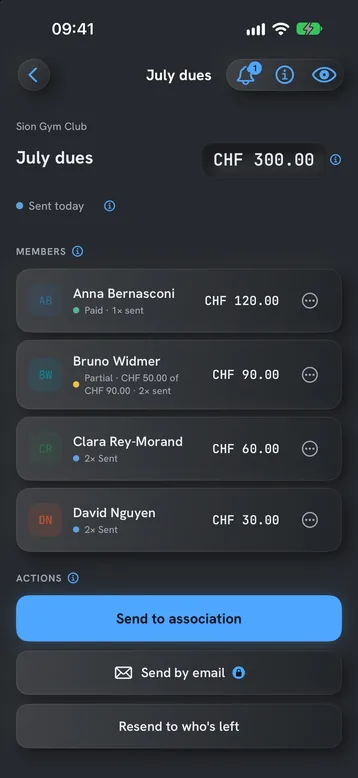
- The fee or an expense to splitThe same amount for each member, or a total divided by shares.
- Every year, on timeThe app prepares the next send. Nothing goes out without you, unless you turn on automatic sending (Pro).
- One reference per member and per sendSCOR with a regular IBAN; QRR with a QR-IBAN. It follows the Swiss Payment Standards (IG v2.3).
- From your emailThe app sends from your account, Gmail or another provider.
- The data stays on the iPhoneNo account. The app does not talk to your bank: you mark who has paid.
Free for one association with up to two members and three active expense reports, no time limit. You can try Pro free for 14 days; then you choose weekly, yearly or a one-time payment, for life. The price is in the App Store.

Download QR Quota for iPhone. One QR-bill per person, each with its own reference, sent from your own email. Free to start, no account.

Frequently asked questions
Does an association have to keep accounts?
Yes. The committee keeps the association's books (Swiss Civil Code, art. 69a). If the association does not have to register in the commercial register, simple bookkeeping is enough: income, expenses and, at the end of the year, what the association has and owes (art. 957 CO, the Code of Obligations).
How long do you keep an association's supporting documents?
Ten years, counted from the end of the financial year (art. 958f CO, the Code of Obligations). On paper or as a file, as long as they can be read.
Who checks the accounts of an association?
In most associations, whoever the statutes and the general meeting decide (art. 69b); often, two auditors elected from outside the committee. An audit body is only compulsory for very large associations, or when a member with personal liability asks for it.
Does an association pay tax on membership fees?
Not for the direct federal tax: members' fees do not count as profit (art. 66 DBG, the Federal Act on Direct Federal Taxation). The canton has its own rules; check with the tax authority.
At what profit does an association pay federal tax?
A profit below CHF 5’000 is not taxed (art. 71 DBG). With ideal purposes, a profit of up to CHF 20’000 is not taxed, if all of it is used for those purposes (art. 66a DBG). Above the limit, the federal rate is 4.25% of the whole profit.
What is the discharge of the committee?
It is the general meeting's decision to accept the year's management. It is usually voted after the accounts are approved and the auditors' report has been read.
About this guide. Informational content. Not legal, accounting or tax advice: what applies to your association is its statutes and the decisions of the tax authority. The examples and the figures in the accounts are invented. The articles cited are from the Swiss Civil Code, the Code of Obligations (CO) and the Federal Act on Direct Federal Taxation (DBG); each one links to the text on Fedlex, in unofficial English translation (the official texts are in German, French and Italian). This guide may contain errors or be out of date: always check the official sources. Updated in October 2026.
Sources (4)
- Fedlex: Swiss Civil Code, articles 60 to 79 (associations), unofficial English translation
- Fedlex: Code of Obligations, articles 957 to 958f (accounting), unofficial English translation
- Fedlex: Federal Act on Direct Federal Taxation (DBG), articles 66, 66a and 71, unofficial English translation
- Fedlex: Swiss Civil Code (ZGB), articles 69a and 69b, in German (the official text)