GuidesQR-bills and contributions
Sports club membership fees in Switzerland: families, juniors and the season
A club has children, adults and families with several kids, and the season starts in August, not in January. Here you see the member categories, what a family pays with a discount and a cap, the season calendar, who has to pay, the reminder and how to split a cost between teams.
Only for people who live in Switzerland.For information. This guide follows Swiss law and Swiss rules. It may contain errors or be out of date: always check the official sources and, if in doubt, ask an official service for help. Not financial, tax or legal advice; for fees and e-banking features, your bank's information applies.
- Member categories
- What a family pays
- The season, month by month
- Income and shared costs
- Who has to pay this year
- The reminder and the conversation
- Everyone's fees, in one go
- Questions
The member categories of a sports club
A football, gymnastics or swimming club is, in most cases, an association. The treasurer or the president looks after the membership fees, and the challenge is almost always the same: there are children, there are adults, there are families with three kids, and the season does not match the calendar year. The starting point is the law, which says little.
CategoriesWhich types of member exist and what they are calledAmountsHow much each category pays, or who sets the amountDeadlineBy when and how to payExemptionsWho does not pay, for example the coaches
The categories do not come from the law. They exist only if the statutes or the general meeting create them. These are the most common:
- JuniorAnyone under a certain age. The club rules say whether the year of birth or the birthday counts.
- Active memberSomeone who plays, trains or competes. The reference amount for the fee.
- FamilySeveral members of the same household, with a discount or a cap. See the calculator below.
- Passive member or supporterSomeone who does not take part in the sport but wants to help the club.
- CoachMany clubs exempt the people who coach the teams. That only holds if the statutes or the general meeting say so.
In practice, the invoice for a junior's fee goes to a parent. It helps if the club rules say who is responsible for payment. The exact form is a matter for your club's statutes: check them.
What does this family pay?
Many clubs give a discount from the second child and set a cap per family. The rule is the club's own: the amount of the fee, the discount and the cap are decided by the general meeting or the statutes (art. 65, art. 71). Try a rule with your own numbers.
A family's membership fee
- Without discount or cap
- With the junior discount
- Total to pay
- The family saves
of the amount without a discount. The cap applies: without it, the family would pay CHF .
The cap cuts CHF . The club goes without that money: add it to the season's accounts.
Write the rule out in full. "The first junior pays the full fee; from the second, 25% less; no family pays more than CHF 450." One sentence like that, in the minutes and in the club rules, prevents conversations at the side of the pitch.
The season, month by month
In a club, the year starts when the season starts: in August or September, in many sports. But the law counts the calendar year. Leaving, for example, is announced six months before the end of the calendar year, or of the financial year if the club has one (art. 70, para. 2). So the list below is ordered by calendar months, not by the months of the season.
- Club tournamentThe party at the end of the season. It brings income, but also costs: bus, food, prizes
- Last day to give notice of leavingIf the financial year is the calendar year, six months before 31 December is 30 June (art. 70, para. 2)
- General meetingApproves the accounts and sets the fee for the next season. The date is the one in the statutes (art. 65)
- RegistrationsRenewals and new juniors. Ask for the email of whoever pays
- Training campThe pre-season. A cost worth budgeting separately
- The fee invoicesOne QR-bill per family or per member, with the deadline written on it
- Licences and competitionsPlayer licences and registrations with the federation. Check the deadlines and the costs with your federation
- The reminderOnly to those who have not paid yet
- The conversationWith whoever is still unpaid. Talk first, before thinking about measures
- Year-end closingIf the financial year is the calendar year, the accounts close on 31 December
Season and financial year are not the same thing. The season is the teams' calendar. The financial year is the year of the accounts. If the statutes set the financial year from 1 July to 30 June, the six months of art. 70 are counted from there. Check the statutes for yours.
The club's income and the costs that get shared
Membership fees are only part of a club's money. An invented example, for a football club with 160 members (70 adults and 90 juniors): fees make up 40% of the income and the rest comes from elsewhere.
Where the money came from: CHF 55’000
| Income | CHF |
|---|---|
| Membership fees (adults and juniors) | 22’000 |
| Local sponsors | 14’000 |
| Tournament and party | 9’000 |
| J+S (illustrative figure only) | 6’000 |
| Municipality | 4’000 |
- J+SThe federal Jugend+Sport (J+S) programme supports clubs and camps with subsidies, through the canton, for youth activities led by trained coaches. The figure in the chart is only there to fill the bar. For the amounts and the conditions, check with the cantonal J+S office.
- Federal taxFor the direct federal tax, members' fees do not count as profit (art. 66 DBG, the Federal Act on Direct Federal Taxation). The canton has its own rules: check with the tax authority.
- The booksThe committee keeps the club's books (art. 69a).
A cost to split between the teams
Some costs do not belong to one team alone: the bus to the tournament, the kits, the balls. A common way is to split one part in equal shares and the rest by the number of players in each team. The committee decides (art. 69), or the general meeting, if the statutes say it is the one. Try it with the slider.
| Team | Players |
|---|---|
| U9 | 14 |
| U11 | 16 |
| U13 | 18 |
| U15 | 12 |
The sum always matches the total to the cent: the remainder of the division goes to the shares with the largest fraction. It is the same rule QR Quota uses.
Does this member have to pay this year's fee?
Three cases often come together in September: someone who gave notice of leaving, someone who was expelled and someone who is exempt. Answer in order.
3. Are they an honorary member, a coach or another category exempted by the statutes or the general meeting?
No Yes5. Did they give notice at least six months before the end of the calendar year (or of the financial year, if the club has one) (art. 70, para. 2)?
Yes NoIf the statutes do not provide for the fee, the club cannot demand it (art. 71). To ask for it, the statutes have to be changed, by the procedure they themselves lay down, normally at a general meeting.
Expulsion follows the rules of the statutes (art. 72). If the fee for the time they were a member is still being asked for, see what the statutes say and decide with the committee, in writing.
Note on the list the reason for the exemption and the decision that provides for it. At the end of the season, that is what you show the general meeting.
They gave notice in time: they leave at the end of the calendar year, or of the financial year. Until then they are a member. Check in the statutes how the fee for the current year and for the next one is handled.
Under the six-month rule (art. 70, para. 2), late notice only counts for the end of the following year (or financial year), unless the statutes give a shorter period. Many clubs handle these cases with common sense (a move to another city, an injury): the decision is the committee's, under the statutes. Write it down.
They are a member and the fee is provided for. Send the invoice and mark it as paid when the money arrives.
The reminder and the conversation: the club is not a bank
A club lives on people who like being there. Collecting a fee is a matter of respect, not of pressure. A sequence that works in many clubs:
- The invoice, with a deadlineOne QR-bill per family or per member, with the due date written on it. Thirty days is a common deadline.
- Mark who has paidAfter the deadline, check the statement and mark the payments by reference.
- The 1st reminderA short email, only to those who are missing: "If you've already paid, thank you, and please ignore this email."
- The conversationA phone call or a few words after training. Ask whether there is a difficulty. Often, a longer deadline is all it takes.
- What the statutes sayOnly afterwards, and only if needed. Expulsion follows the rules of the statutes (art. 72) and, in principle, it is the general meeting that decides it (art. 65).
Who has paid and who has not is each family's business. Do not send the list of late payers to everyone, and do not post it at the club. Talk to the parents and not to the junior: a child does not choose who pays.
Before the season's 1st invoice
A list to tick off as you go. It is saved only in this browser.
- The statutes provide for the fee. And they say who sets the amount (art. 71).
- The general meeting decided the season's amounts. With the date in the minutes.
- The junior age is defined. Year of birth or birthday.
- The member list is up to date. Who left in time (art. 70, para. 2), who joined, who changed category.
- Every child has the email of whoever pays. And the families are grouped.
- The family discount and the cap are calculated. Family by family, with the rule written down.
- The IBAN and the club's name are right. Read the first QR-bill with your bank's app, without confirming the payment.
- The letter says what the fee includes, and the deadline. To avoid doubts at the side of the pitch.
The fees of all the members, in one go
- The members, onceName, email and form of address
- The season's feeThe same for everyone, or by shares
- One QR-bill per memberEach with its own reference
- Who has paidYou mark it; you resend only to those who haven't
That is what QR Quota is for, an app for iPhone. It starts from the club, not from a single invoice. For juniors, you record the name and the email of the mother or father, and that is who the invoice goes to.
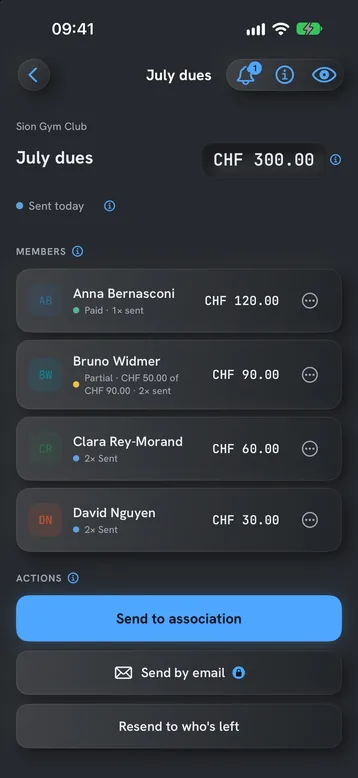
- The same fee, or a total by sharesThe same amount for each member, or a total divided by the shares the club chooses, as in the bus split.
- One reference per member and per sendSCOR with a regular IBAN; QRR with a QR-IBAN. It follows the Swiss Payment Standards (IG v2.3).
- Reports with expense linesSent by year or by month. After the first send, the lines are locked.
- From your emailThe app sends from your account, Gmail or another provider. Nothing goes out without you, unless you turn on automatic sending (Pro).
- The data stays on the iPhoneNo account. The app does not talk to your bank: you mark who has paid.
Free for one association with up to two members and three active expense reports, no time limit. You can try Pro free for 14 days; then you choose weekly, yearly or a one-time payment, for life. The price is in the App Store.
For the fee of each member of an association, the guide Collect your association's membership fees has the email templates and the reminders. For the year's accounts, the guide The treasurer of an association.

Download QR Quota for iPhone. One QR-bill per person, each with its own reference, sent from your own email. Free to start, no account.

Frequently asked questions
Can a sports club charge its members a membership fee?
Only if the statutes provide for it (Swiss Civil Code, art. 71). The amount and the categories are set by the statutes or the general meeting (art. 65).
How do you leave a sports club in Switzerland?
Any member can leave. Give notice six months before the end of the calendar year, or of the financial year if the club has one (art. 70, para. 2). Check the statutes for rules of their own.
Can a club expel a member who doesn't pay the fee?
Expulsion follows the rules of the statutes (art. 72). Check what your club's statutes say about late payment and who decides.
How much should a family with several children pay?
No amount is set by law. The statutes or the general meeting decide the fee, the discount from the second child and the cap per family (art. 65, art. 71).
Are sports club membership fees subject to federal tax?
For the direct federal tax, members' fees do not count as profit (art. 66 DBG). The canton has its own rules: check with the tax authority.
About this guide. Informational content. Not legal, financial or tax advice: what applies to your club is its statutes, its rules and the decisions of the general meeting. The examples and the numbers are invented, including the J+S figure, which only illustrates the chart. The articles cited are from the Swiss Civil Code and the Federal Act on Direct Federal Taxation (DBG); each one links to the text on Fedlex, in unofficial English translation (the official texts are in German, French and Italian). This guide may contain errors or be out of date: always check the official sources. Updated in October 2026.