GuidesQR-bills and contributions
Collect your association's membership fees: from the general meeting to the last reminder
In Switzerland, an association can only charge membership fees if its statutes provide for them. Here you see who sets the amount, what goes into each member's QR-bill, what to write in the email and the reminders, and how to know who has paid.
Only for people who live in Switzerland.For information. This guide follows Swiss law and Swiss rules. It may contain errors or be out of date: always check the official sources and, if in doubt, ask an official service for help. Not financial, tax or legal advice; for fees and e-banking features, your bank's information applies.
- What the law says
- Who decides the amount
- The fee year
- The fee QR-bill
- Email templates
- Who has paid
- Questions
What does the law say about membership fees?
In Switzerland, associations are governed by the Civil Code (articles 60 to 79). On membership fees, also called club dues or annual fees, the law says little and leaves the rest to the articles of association. Swiss associations usually call them "statutes", and so does this guide. The statutes must be in writing and state the association's purpose, its resources and its organisation (art. 60).
Art. 71There are membership fees only if the statutes provide for themArt. 70A member who leaves gives six months' notice, before the end of the calendar year or of the financial yearArt. 73A member who leaves or is expelled owes the fees for the time they were a memberArt. 75aThe association's assets are liable for its debts, unless the statutes say otherwise
FeeWhether there is a fee and who sets the amountCategoriesActive, junior, family, supporting, honoraryDeadlineThe date by which to payLate paymentWhat happens to members who don't pay
Statutes first. If they say nothing about fees, the association cannot demand them (art. 71). The statutes are changed by the procedure they themselves lay down, usually at a general meeting.
Who decides the amount of the membership fee?
Many associations do not write the amount into the statutes. They write who sets it: often the general meeting (AGM), every year. That way the amount changes without changing the statutes. And many have categories, each with its own amount. For example:
- Active memberThe standard fee.
- Family membershipOne amount for the whole household, often lower than the total for several individual members.
- Supporting memberSomeone who does not take part but wants to help. Sometimes with a minimum amount and the rest up to them.
- Honorary memberOften exempt.
When the general meeting sets the fee, it writes the amount and the date in the minutes. If anyone asks why they pay that amount, the minutes are what you show them.
The fee year, from the general meeting to closing the accounts
An example calendar. The right deadlines are the ones in your statutes.
- General meetingSets the fee for the year
- The sendOne QR-bill per member
- The deadlineThe date by which to pay
- 1st reminderOnly to those who haven't paid
- The accountsThe list of who has paid goes to the general meeting
Members who leave mid-year. By law, a member gives six months' notice before the end of the calendar year or, if the statutes provide for one, of the financial year (art. 70). And they owe the fees for the time they were a member (art. 73).
The fee QR-bill: what changes from member to member
The account and the association are the same for everyone. The amount, the reference and the payer change.
- 1AccountThe association's IBANRequired
- 2PayeeThe association, the account holderRequired
- 3ReferenceOne per member and per yearRecommended
- 4MessageFor example "Membership fee 2027 – Jane Smith"Optional
- 5PayerThe member, with addressOptional
- 6CurrencyCHFRequired
- 7AmountThe fee for their categoryOptional
- 8Swiss QR CodeHolds all this dataRequired
Each member has their own. The reference comes back with the payment and says who paid, even if the money comes from someone else's account.
That works too: the message carries the name and the year. But if a parent pays a child's fee, the bank statement shows the parent's name.
All the fields, IBAN or QR-IBAN and the 2026 rules are in the guide Create a QR-bill.
Templates: the fee email and the reminders
Three templates to copy. Replace whatever is in square brackets. Adjust the tone to your members, formal or friendly.
Subject: Membership fee 2027 – [association]
Dear [name],
At the general meeting on [date], the 2027 membership fee was set at CHF [amount].
Your QR-bill is attached. You can pay it in e-banking or in your bank's app by [date].
Thank you for being part of [association]. Kind regards, [Your name], Treasurer
Subject: Reminder – 2027 membership fee
Hello [name], I have not yet recorded your payment of the 2027 membership fee (CHF [amount]).
If you have already paid, thank you, and please ignore this email. If not, I am attaching the QR-bill again. The new deadline is [date]. Kind regards, [Your name], Treasurer
Subject: 2027 membership fee still unpaid
Dear [name], the 2027 membership fee (CHF [amount]) is still unpaid. Could you please pay it by [date]?
Under the statutes (art. [number]), [what happens to members who don't pay]. If you are having any difficulty, please get in touch with me. Kind regards, [Your name], Treasurer
One email per member. Who has paid and who has not is each member's own business. Don't send the list of late payers to everyone; for an email to many people, use Bcc.
Knowing who has paid, and what to do about those who haven't
- The bank statementThe payments that came in
- The referenceOr the message, says whose it is
- Mark as paidWith the date
- ReminderOnly to those who haven't paid
It depends on the statutes. Some provide that, after a reminder goes unanswered, the member can be expelled. If the statutes say nothing, expulsion can only be decided at a general meeting, and only for good cause (art. 72). In any case, the fee for the time they were a member remains due (art. 73).
The committee keeps the association's books (art. 69a). The fees paid and those still unpaid go into the accounts that go to the general meeting.
The fees of all members, at once
- The members, onceName and email
- One annual feeRepeats every year
- One QR-bill per memberEach with its own reference
- Who has paidYou mark it; you resend only to those who haven't
That is what QR Quota is for, an app for iPhone. It starts from the association, not from a single invoice.
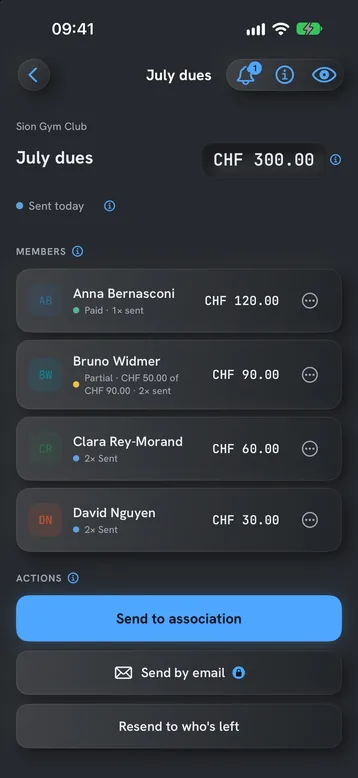
- The same amount for each memberOr a total divided by shares, as in a condominium.
- Every year, on timeThe app prepares the next send. Nothing goes out without you, unless you turn on automatic sending (Pro).
- One reference per member and per sendSCOR with a regular IBAN; QRR with a QR-IBAN. It follows the Swiss Payment Standards (IG v2.3).
- From your emailThe app sends from your account, Gmail or another provider.
- Members don't need the appThey pay the PDF in e-banking, like any QR-bill.
- The data stays on the iPhoneNo account. The app does not talk to your bank: you mark who has paid.
Free for one association with up to two members and three active expense reports, no time limit. You can try Pro free for 14 days; then you choose weekly, yearly or a one-time payment, for life. The price is in the App Store.

Download QR Quota for iPhone. One QR-bill per person, each with its own reference, sent from your own email. Free to start, no account.

Frequently asked questions
Can an association require its members to pay membership fees?
Only if the statutes provide for it (Swiss Civil Code, art. 71). The statutes also say who sets the amount; often, it is the general meeting.
Who sets the membership fee?
Whoever the statutes say. Many leave the decision to the general meeting, every year; that way the amount changes without changing the statutes. The decision is recorded in the minutes.
Does a member who leaves still have to pay the fee?
They owe the fees for the time they were a member (art. 73). And, by law, a member who leaves gives six months' notice before the end of the calendar year or, if the statutes provide for one, of the financial year (art. 70).
What happens to members who don't pay their fee?
It depends on the statutes. Some provide for expulsion after a reminder goes unanswered. If they say nothing, expulsion can only be decided at a general meeting and for good cause (art. 72). A fee that is already due remains due.
Does the QR-bill for the fee need a reference?
It is not mandatory. With a regular IBAN, the QR-bill can go without a reference, with just a message. A reference per member helps you see who has paid, even when the money comes from someone else's account.
Do members have to install an app?
No. They receive the QR-bill as a PDF and pay in e-banking or in their bank's app, like any other QR-bill.
About this guide. Informational content. Not financial, tax or legal advice: what applies to your association is its statutes. The article numbers cited are from the Swiss Civil Code; each one links to the official text on Fedlex. This guide may contain errors or be out of date: always check the official sources. Updated in October 2026.
Sources (4)
- Fedlex: Swiss Civil Code, articles 60 to 79 (associations), unofficial English translation
- Fedlex: Swiss Civil Code (ZGB), articles 60 to 79, in German (the official text)
- SIX: QR-bill (QR reference, QR-IBAN, SCOR), in German
- SIX: Swiss Implementation Guidelines for the QR-bill, version 2.3 (PDF, in English)