GuidesQR-bills and contributions
Splitting condominium (PPE) costs: from the per mille shares to the year-end settlement
In a building under condominium ownership, each unit owner pays the common charges in proportion to their quota. Here you see what the per mille shares are, how to split an expense to the cent, what counts as a common charge, the condominium year, the settlement of the advance payments, the owners' meeting and the majorities for works.
Only for people who live in Switzerland.For information. This guide follows Swiss law and Swiss rules. It may contain errors or be out of date: always check the official sources and, if in doubt, ask an official service for help. Not financial, tax or legal advice; for fees and e-banking features, your bank's information applies.
- The per mille shares
- Splitting to the cent
- What counts as common charges
- The condominium year
- Advance payments and settlement
- The owners' meeting and the minutes
- Works: who decides
- One QR-bill per unit
- Questions
What are the per mille shares, and who decides them?
In a building under condominium ownership (PPE in French, Stockwerkeigentum in German), each unit owner has the exclusive right to use and fit out the inside of their unit (art. 712a) and shares the common parts with the others: stairs, roof, façade, land. Each owner's part of the common areas is called the quota. It is written as a fraction over a common denominator, often 1000: these are the per mille shares (‰). A unit with 210 ‰ has 210 parts in 1000, which is 21% (art. 712e).
For common expenses there is one rule: each owner pays in proportion to their quota (art. 712h para. 1 CC).
Art. 712eQuotas are expressed as a fraction with a common denominator: per mille, per centArt. 712hOwners contribute to the common charges in proportion to their quotasArt. 712gThe regulations are adopted or changed by a majority of the owners that also represents more than half of the quotasArt. 712mThe owners' meeting approves the budget, the accounts and the split of the costs
Quotas are not adjusted in the settlement. Changing the quota of a unit needs the agreement of the owners directly concerned and the approval of the owners' meeting (art. 712e). If a per mille share looks wrong, that is the way to fix it, not a discount in the accounts. In simple co-ownership, without floors, quotas are presumed equal (art. 646) and charges are split by quota, unless agreed otherwise (art. 649).
Splitting an expense across the units, to the cent
An invented building, with six units and 1000 ‰ in total. Type another expense, or change a per mille share, and see each unit's part. You can add units or remove some.
Each unit's expense
| Unit | Per mille |
|---|---|
| Unit 1 · 2nd floor left | 210 |
| Unit 2 · 2nd floor right | 190 |
| Unit 3 · 1st floor left | 170 |
| Unit 4 · 1st floor right | 160 |
| Unit 5 · ground floor | 150 |
| Unit 6 · attic | 120 |
With CHF 24’000 the sum is exact. It rarely is: most expenses are not a neat multiple. Try CHF 1’000.10 as the total. The sum still has to equal the total, and the leftover cents go to the larger fractions, with a tie favouring the upper row. Here, units 2, 3 and 4 get one cent more (their exact share ends in .9, .7 and .6 of a cent), and the sum is CHF 1’000.10.
The remainder rule. Each unit starts with the whole cents it is entitled to. The leftover cents are given, one by one, to the units whose share had the largest fraction. Nobody pays more than one cent of difference, and the total always closes.
What counts as common charges?
The law gives a list of examples (art. 712h para. 2 CC). Common charges are, above all:
- Maintenance, repairs and renovationsOf the common parts: roof, façade, stairs, lift, shared pipes.
- AdministrationIncludes the administrator's pay.
- Public fees and taxesThose on the common parts.
- Debts secured on the buildingThe interest and the repayments.
A yearly budget for an invented building, with the same CHF 24’000 as above:
Where the year's money goes: CHF 24’000
| Charge | CHF |
|---|---|
| Day-to-day maintenance and repairs | 6’000 |
| Energy for the common parts | 5’400 |
| Renovation fund | 4’200 |
| Administration | 3’600 |
| Building insurance | 2’400 |
| Cleaning and garden | 2’400 |
The renovation fund exists only if the owners' meeting creates it (art. 712m para. 1 no. 5 CC). For big works, see the guide Renovation fund of a condominium.
Is every expense split by per mille?
Not every one. The law says that if a part of the building or an installation serves some owners not at all, or very little, this is taken into account in the split (art. 712h para. 3 CC). Answer for an expense in your building:
1. Is the expense for a common part of the building, such as the roof, the façade, the stairs or the administration?
Yes No, it is for the inside of a unit2. Does it serve all the owners, or can all of them use it?
Yes No, it serves only some (or serves some very little)3. Do the regulations provide for measuring each unit's consumption, for example with a water or heat meter, and does the expense depend on that consumption?
Yes NoThis is the normal case: expense × the unit's per mille ÷ 1000 (art. 712h para. 1 CC).
The fact that the part serves some owners not at all, or very little, is taken into account (art. 712h para. 3 CC). Examples: the lift for the ground-floor unit, or a garage only for those who have a space. How the difference is measured, check in the regulations or in the owners' meeting decision.
For what is spent according to use, the regulations can split by measured consumption. Check in the regulations how the meter is read and which part stays with the per mille shares.
The owner has the exclusive right to use and fit out the inside of their unit (art. 712a). What the regulations say about the limits stays in the regulations.
The condominium year, from the budget to the settlement
An example for a condominium whose year is the calendar year. The right dates are those of the regulations and of the owners' meeting.
- Advance paymentsEach unit pays a part of the budget, every quarter
- Closing the accountsInvoices, statements, meter readings, the year's real total
- Final statementEach unit's real expense, by per mille
- Owners' meetingApproves the accounts and the split, and votes the budget (art. 712m)
- SettlementEach unit pays the difference, or receives it
- Next year's budgetThe administrator prepares it, the meeting approves it
The budget is a forecast. The units' advance payments give the community money to pay with during the year. At the end, the real accounts say who paid too little and who paid too much.
Advance payments against the real cost: one unit's settlement
In the example, the budget was CHF 24’000 and the year cost CHF 25’800. Maintenance and energy came out dearer than forecast.
Budget and real cost, by charge
| Charge | Budget | Real |
|---|---|---|
| Maintenance and repairs | 6’000 | 7’300 |
| Energy for the common parts | 5’400 | 5’900 |
| Renovation fund | 4’200 | 4’200 |
| Administration | 3’600 | 3’600 |
| Building insurance | 2’400 | 2’400 |
| Cleaning and garden | 2’400 | 2’400 |
Now one unit's settlement. Type the year's real total, the unit's per mille share and what the unit has already advanced. The example unit is the ground-floor one (150 ‰), which advanced CHF 3’600.
One unit's settlement
- The unit's real share
- Already advanced
- To pay
- To receive
The advance payments cover of the real share.
The unit advanced less than its share: it pays the difference after the owners' meeting approves the accounts.
The unit advanced more than its share: the difference goes back to the unit, or is deducted from the next advance payments, depending on the regulations.
The advance payments were exactly the real share: nothing to pay or to receive.
A unit cannot have more than 1000 ‰.
A single line, rounded to the cent: when you split the total across all the units, one line's cent may differ from what comes out here (remainder rule, above).
Before you send the statement to the owners, here is a list to tick off. It is saved only in this browser.
- The per mille shares add up to 1000. If they add up to 998 or 1002, a unit is missing or extra.
- Each unit has the right quota. The one in the PPE documents; changing it needs the owners' meeting (art. 712e).
- Each expense has a supporting document. An invoice, a receipt or a note with the reason.
- Expenses with their own key are kept apart. Lift, garage, consumption (art. 712h para. 3 CC).
- Each unit's advance payments match the statement. All the quarters, unit by unit.
- The sum of the shares equals the total, to the cent. If not, the remainder was spread wrongly.
- Each unit's difference has the right sign. Positive: to pay. Negative: to receive.
- Everything goes to the owners' meeting and the minutes. The accounts and the split are approved there (art. 712m para. 1 no. 4 CC).
What the owners' meeting approves, and the minutes
The owners' meeting decides several things; three of them touch the accounts directly (art. 712m para. 1 CC). The rules on associations apply to the meeting (art. 712m para. 2 CC).
- The budgetThe year's plan and the advance payments (no. 4)
- The accounts and the splitWhat it cost, and what each unit owes (no. 4)
- The renovation fundCreating a fund for repairs and renovations (no. 5)
- The insuranceInsuring the building (no. 6)
Each decision goes into the minutes, the written record of what was decided (art. 712n). The minutes are what you show an owner who asks why they pay that amount.
The community has a statutory lien on each owner's unit for the contributions of the last three years (art. 712i). It means that if someone stops paying, the community has a guarantee on that unit. In practice, the first step is almost always to talk to the owner. If the case is serious, the administrator and a lawyer say what to do.
Works: how many owners have to agree?
For works, condominium ownership follows the rules of co-ownership (art. 712g). The majority needed depends on the kind of work. Choose one.
Necessary maintenance works (art. 647c): those that keep the value and usefulness of the building. A majority of all the co-owners decides.
Example: repairing the roof, replacing a boiler that broke down.
Useful works (art. 647d): they increase the value or the income of the building. A majority of the co-owners that also represents the majority of the quotas decides.
Example: a more efficient heating system, a shared electric charger.
Luxury works (art. 647e): for embellishment or comfort. As a rule, they need all the co-owners, with the exception the law provides for.
Example: a winter garden, a fountain in the courtyard.
If in doubt, ask. The line between a useful work and a luxury one is not always clear, and the regulations may have their own rules (art. 712g). For big works, the money often comes from the renovation fund: see the guide Renovation fund of a condominium.
One QR-bill per unit, every quarter
- The owners, onceName and email of each unit
- The per mille shares as weightsThe total is split by them, to the cent
- One QR-bill per unitEach with its own reference
- Who has already paidYou tick it off; you resend only to those missing
This is what QR Quota is for, an app for iPhone. The condominium is the group (the “association” in the app), the owners are the members and the per mille shares are the weights.
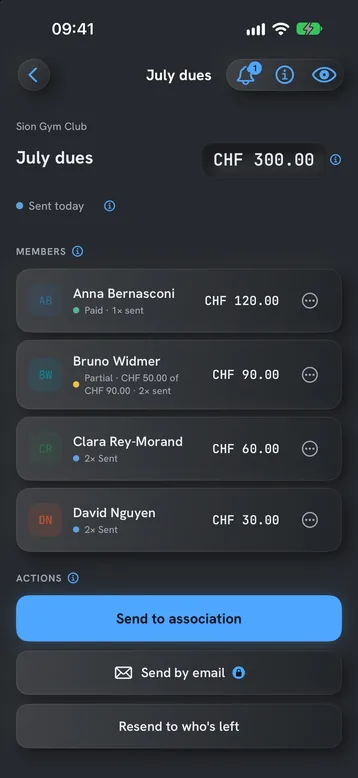
- The total split by per milleYou type the quarter's total; the app splits it by the weights, to the cent.
- The year's settlement, as an expense reportThe year's expense lines, sent by year and month. After the first send, the lines are locked. The advance payments already made, you deduct yourself.
- One reference per unit and per sendSCOR with the normal IBAN; QRR with the QR-IBAN. It follows the Swiss Payment Standards (IG v2.3).
- From your emailThe app sends from your account, Gmail or another provider. Automatic sending is part of Pro.
- The data stays on the iPhoneNo account. The app does not talk to your bank: who has paid, you tick off.
Free for one association with up to two members and three active expense reports, no time limit. A building with more units needs Pro. You can try Pro free for 14 days; then you choose weekly, yearly or a one-time payment, for life. The price is in the App Store.

Download QR Quota for iPhone. One QR-bill per person, each with its own reference, sent from your own email. Free to start, no account.

Frequently asked questions
How are condominium costs calculated in Switzerland?
Each owner pays in proportion to their quota (art. 712h para. 1 CC): expense × the unit's per mille ÷ 1000. The owners' meeting approves the budget, the accounts and the split (art. 712m para. 1 no. 4 CC).
What are per mille shares in a PPE?
They are each unit's quota in the common parts, written as a fraction over 1000. A unit with 210 ‰ has 21% (art. 712e). Changing a quota needs the agreement of those directly concerned and the approval of the owners' meeting.
What counts as common charges in a PPE?
Above all day-to-day maintenance, repairs and renovations of the common parts, administration (including the administrator's pay), public fees and taxes, and the interest and repayments of debts secured on the building (art. 712h para. 2 CC).
Do I pay the same share of the lift if I live on the ground floor?
The law says that if a part of the building or an installation serves some owners not at all, or very little, this is taken into account in the split (art. 712h para. 3 CC). How it is measured, check in the regulations or the owners' meeting decision.
Who approves the condominium accounts and budget?
The owners' meeting approves the yearly budget, the accounts and the split of the costs (art. 712m para. 1 no. 4 CC). The decision goes into the minutes (art. 712n).
What happens if an owner does not pay the condominium costs?
The community has a statutory lien on the owner's unit for the contributions of the last three years (art. 712i). In practice, the first step is almost always to talk to the owner; for the rest, check with a lawyer.
About this guide. Informational content. Not legal or accounting advice: what applies to your condominium are the regulations, the deed constituting the PPE and the decisions of the owners' meeting. The examples, the units, the per mille shares and the numbers are invented. The articles cited are from the Swiss Civil Code; each one links to the official text on Fedlex, in an unofficial English translation. This guide may contain errors or be out of date: always check the official sources. Updated in October 2026.
Sources (6)
- Fedlex: Swiss Civil Code, articles 712a to 712t (condominium ownership), unofficial English translation
- Fedlex: Swiss Civil Code, article 712e (the quotas), unofficial English translation
- Fedlex: Swiss Civil Code, articles 712h and 712i (the common charges and the statutory lien), unofficial English translation
- Fedlex: Swiss Civil Code, articles 712m and 712n (the owners' meeting and the minutes), unofficial English translation
- Fedlex: Swiss Civil Code, articles 646 to 649 (co-ownership), unofficial English translation
- Fedlex: Swiss Civil Code (ZGB), article 712h, in German (the official text)