GuidesQR-bills and contributions
The renovation fund of a condominium in Switzerland: how much to set aside and who decides on works
In a building under condominium ownership, the roof, the facade and the elevator belong to everyone, and one day they cost a lot. Here you see what the renovation fund is, who it belongs to, what your unit pays, who decides on a work and how decisions are recorded. With a simulator of the fund over 25 years.
Only for people who live in Switzerland.For information. This guide follows Swiss law and Swiss rules. It may contain errors or be out of date: always check the official sources and, if in doubt, ask an official service for help. Not financial, tax or legal advice; for fees and e-banking features, your bank's information applies.
- What the fund is
- The fund over the years
- What your unit pays
- How long each thing lasts
- Who decides on a work
- From proposal to accounts
- All the contributions, at once
- Questions
What is the renovation fund of a condominium (PPE)?
PPE stands for propriété par étages, the Swiss term for condominium ownership (in German, Stockwerkeigentum): each person owns their own apartment (the unit) and, together, everything that is shared, such as the roof, the facade, the stairwell and the elevator. Each owner is a unit owner. One day the roof will have to be redone. The renovation fund is the money put aside, year after year, for that day.
The law gives the owners' meeting the power to create a fund for repairs and renovations (art. 712m). It is the meeting that decides to create it, and the building's regulations say how it works. Check yours to see whether the building has one.
The workThe roof costs CHF 120’000The unitA unit of 150 ‰ pays CHF 18’000 at onceThe riskSome owners may not have the money that year, and the work is delayed
The workThe same roof, paid from the fund, if it holds the moneyThe unitThe same unit has been paying a little every yearThe differenceNo shock for anyone's wallet; the money was already set aside
The community of unit owners acquires in its own name what results from the administration, in particular the contributions and the renovation fund (art. 712l). There is one fund, and it belongs to the community. So whoever sells an apartment, as a rule, does not take their share: it stays in the fund, for the building. Check the regulations and the purchase contract, which is where you see whether the price took that into account.
The fund over the years: is it enough for the works?
An example of a building with four big works over 25 years: painting the stairwell, the roof, the elevator and the facade. Move the two sliders. The numbers are invented and leave out interest and inflation: the chart is there so you can see the shape.
Renovation fund simulator
| Year | Work | Cost (CHF) |
|---|---|---|
| 6 | Painting the stairwell | 25’000 |
| 12 | Roof | 120’000 |
| 18 | Elevator | 90’000 |
| 23 | Facade | 140’000 |
With CHF 40’000 in the fund and CHF 8’000 a year, the money runs out in year 12, with the roof.
When the balance goes negative the work has arrived before the money. There are two ways out: contribute more every year, or pay what is missing in one go, split by the quotas (art. 712h). The earlier you start, the smaller the yearly contribution.
How much does my unit pay per year?
Unit owners contribute to the common costs in proportion to their quotas (art. 712h). Each unit's quota is a fraction of the building, in per mille (‰) or in hundredths: 85 ‰ means 85 parts in 1’000. To find yours, look at the regulations or at the deed of your apartment.
My unit's share
- Per year
- Per quarter
- Per month
- Your share of the extra work
Your unit is of the building, and pays that share of the common costs.
A unit cannot have more than 1’000 ‰: the whole building is 1’000 ‰. Check the number in the regulations.
The amount of the contribution does not come from the law: it is whatever the regulations or the meeting decide. Some regulations set it as a percentage of the building's insured value. It is only an example:
Now the whole building, unit by unit. The split to the cent is the same rule as in the app: the sum always equals the total, not a cent more or less. Change the total, the weights or the names.
| Unit | Per mille |
|---|---|
| 1st floor, left | 100 |
| 1st floor, right | 120 |
| 2nd floor, left | 150 |
| 2nd floor, right | 180 |
| 3rd floor, left | 200 |
| Penthouse | 250 |
- It is not always all equalIf a part of the building or an installation does not serve certain unit owners, or serves them very little, this is taken into account in the split (art. 712h). One possible example: the elevator and the ground-floor unit.
- Who does not payThe community has the right to a legal mortgage on each unit owner's unit for the contributions of the last three years (art. 712i).
How long does each thing last?
A simple rule for setting the contribution: list what the building has, what it costs and how many years pass before it is redone. These are only orders of magnitude for the example; every building is different. Ask a professional to look at yours.
Lifespan in years (example values)
| Component | Years (example) |
|---|---|
| Painting of the common areas | 10 |
| Heating (boiler) | 20 |
| Elevator | 25 |
| Windows | 30 |
| Facade | 30 |
| Roof | 40 |
The sum is: replacement cost ÷ years of life = how much to put aside per year. Add everything up and you get the building's contribution.
For example, a roof of CHF 120’000 that lasts 40 years calls for CHF 3’000 a year. Add up the other components and you have an idea of the fund. The final figure is whatever the meeting approves.
Who decides on this work?
For acts of administration and for works, the rules of co-ownership apply (art. 712g). How many people have to vote in favour depends on the type of work. Answer:
1. What type of work is it?
Necessary: keeps the building in good condition (a leaking roof, a burst pipe) Useful: raises the value or the income of the building (better insulation, solar panels) Luxury (sumptuary): beautifies or adds comfort (an entrance hall entirely in marble)Necessary maintenance works are decided by the majority of all the unit owners (art. 647c). Those who don't vote, or are absent, count: it is the majority of the total, not only of those present.
Useful works need the majority of the unit owners that also represents the majority of the quotas (art. 647d). The number of people counts, and so does the weight of the units.
Luxury works need all the unit owners (art. 647e), with the exception the law itself provides. It is the hardest rule: a single vote against stops the work.
If in doubt about which group a work falls into, ask a professional or the administrator before the meeting. The regulations count too: check them.
Once the work is decided, the question is how to pay for it. There are three ways.
- From the fundThe meeting decides to use what is set aside. It can only go as far as the balance reaches.
- By an extra contributionWhat is missing is collected, split by the quotas (art. 712h). That is the case in the simulator, when the balance goes negative.
- By a debtThe interest and repayment of debts secured by the property count among the common costs (art. 712h). It is the last choice: talk to the administrator first.
From proposal to accounts: the fund, step by step
The administrator carries out the meeting's decisions, splits the costs, collects the contributions and manages the funds (art. 712s). The meeting decides. One possible path for a work:
- ProposalA unit owner or the administrator says what the problem is and proposes to deal with it. Good photos and a short note help.
- QuotesSeveral are requested, with the same scope, so they can be compared. The unit owners receive them before the meeting.
- MeetingThe work, the chosen quote and the way to pay are voted on. The decision goes into the minutes (art. 712n).
- WorkThe administrator carries out the decision. If the work is split into parts, each invoice goes into the file.
- AccountsAt the end, the invoices go into the accounts, which the meeting approves together with the split of the costs (art. 712m). The fund balance carries over to the next year.
Before the meeting that decides on a work, tick off the list as you go. It is saved only in this browser.
- The problem is described. With photos and, if possible, a professional's opinion.
- There is more than one quote. With the same scope, so they can be compared.
- You know the type of work. Necessary, useful or luxury, because it sets the majority needed (art. 647c, art. 647d, art. 647e).
- The fund balance is in plain sight. How much there is, and how much is missing if the work exceeds it.
- The way to pay is in the proposal. Fund, extra contribution or debt, with each unit's share.
- The agenda has reached everyone. With the documents, and in time, as the regulations say.
- Someone takes the minutes. The decision and the result of the vote are written down (art. 712n).
- The accounts of the work are kept apart. So you can see what came out of the fund and what came from extra contributions.
The fund and the contributions, at once
Each unit pays its share, every year. In QR Quota, an app for iPhone, the building is an «association» and each unit is a «member». The rest follows what you saw above.
- The units, onceName, email and form of address
- The year's totalDivided by each unit's per mille
- One QR-bill per unitEach with its own reference
- Who has paidYou mark it; you resend only to those who haven't
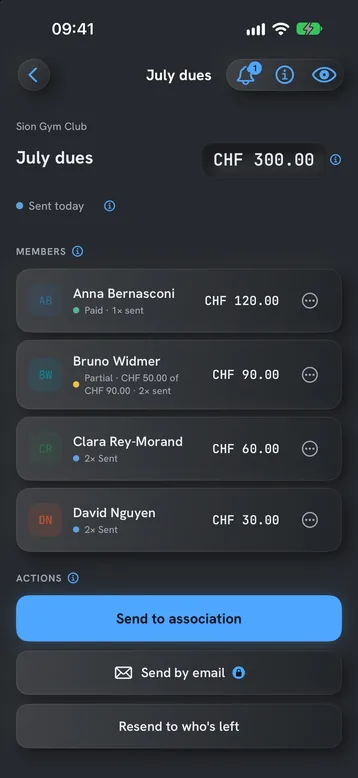
- The fund divided by the weightsThe fund's yearly contribution, split by each unit's per mille, to the cent.
- An extra work, as an expense reportThe work's expense lines, divided by the quotas. After the first send, the lines are locked.
- One reference per unit and per sendSCOR with a regular IBAN; QRR with a QR-IBAN. It follows the Swiss Payment Standards (IG v2.3).
- From your emailThe app sends from your account, Gmail or another provider. Yearly or monthly; automatic sending is Pro.
- The data stays on the iPhoneNo account. The app does not talk to your bank: you mark who has paid.
Free for one association with up to two members and three active expense reports, no time limit. You can try Pro free for 14 days; then you choose weekly, yearly or a one-time payment, for life. The price is in the App Store.
Other guides: splitting condominium costs and creating a QR-bill.

Download QR Quota for iPhone. One QR-bill per person, each with its own reference, sent from your own email. Free to start, no account.

Frequently asked questions
Is the renovation fund of a condominium (PPE) mandatory?
The law gives the owners' meeting the power to create a fund for repairs and renovations (Swiss Civil Code, art. 712m). The meeting decides whether to create it; check your building's regulations to see if there is one.
Who owns the renovation fund of a condominium?
The community of unit owners, not each owner: the community acquires in its own name the contributions and the renovation fund (art. 712l).
If I sell my apartment, do I get my share of the renovation fund back?
As a rule, no: since the fund belongs to the community (art. 712l), it stays with the building. Check the regulations and the purchase contract to see whether the price took that into account.
How are the costs of works split between unit owners?
In proportion to each unit's quota (art. 712h). If a part of the building serves certain unit owners very little, this is taken into account in the split.
Who decides on works in a condominium building?
The owners' meeting, under the rules of co-ownership (art. 712g): a majority of all owners for necessary works (art. 647c), a double majority for useful works (art. 647d) and unanimity for luxury works (art. 647e).
What happens to an owner who does not pay the contributions?
The community has the right to a legal mortgage on the owner's unit for the contributions of the last three years (art. 712i).
About this guide. Informational content. Not legal or technical advice: what applies to your building are its regulations, the decisions of the owners' meeting and the purchase contract. The examples and the numbers are invented. The articles cited are from the Swiss Civil Code (condominium ownership and co-ownership); each one links to the text on Fedlex, an unofficial English translation (the official texts are in German, French and Italian). This guide does not cover taxes. This guide may contain errors or be out of date: always check the official sources. Updated in October 2026.
Sources (5)
- Fedlex: Swiss Civil Code, articles 712a to 712t (condominium ownership), unofficial English translation
- Fedlex: Swiss Civil Code, articles 712h and 712i (the common costs), unofficial English translation
- Fedlex: Swiss Civil Code, articles 712l, 712m and 712n (the fund, the meeting, the minutes), unofficial English translation
- Fedlex: Swiss Civil Code, articles 647c to 647e (the works), unofficial English translation
- Fedlex: Swiss Civil Code (ZGB), articles 712a to 712t, in German (the official text)