GuidesQR-bills and contributions
Split the costs of a flatshare: from the rent to the deposit
In a flatshare (WG, or colocation), somebody handles the rent and the bills. Here you see who answers to the landlord, how to split the rent by room, the ancillary costs and the yearly settlement, the deposit, the shared costs and what to do when someone moves out or in.
Only for people who live in Switzerland.For information. This guide follows Swiss law and Swiss rules. It may contain errors or be out of date: always check the official sources and, if in doubt, ask an official service for help. Not financial, tax or legal advice; for fees and e-banking features, your bank's information applies.
- Who signed the lease
- The rent, room by room
- Ancillary costs and the settlement
- The rent deposit
- Shared household costs
- Moving out and moving in
- Questions
Who signed the lease?
A shared flat is called a WG in German (Wohngemeinschaft) and a colocation in French. Before you split the money, check who signed what, because that decides who answers to the landlord. There are two models.
All flatmates sign the lease with the landlord: they are co-tenants. As a rule, each of them is liable for the whole rent, not only for their own share. The lease usually says so. The law only recognises that joint liability if it is declared or provided for by law (art. 143). Joint liability means the landlord can claim the whole debt from any one of them (art. 144). Between yourselves, each person bears an equal share, unless you agree otherwise (art. 148).
- The flatmatesEach pays their share
- One accountOr one flatmate who collects and pays
- The landlordReceives the whole rent
- If one fails to payThe landlord can claim everything from any one of you
Only one person signs with the landlord: the main tenant. The others rent a room from them and are subtenants. To sublet, the main tenant needs the landlord's consent (art. 262). The landlord can only refuse in three cases:
1The tenant did not tell the landlord the terms of the sublet2The terms are abusive compared with those of the main lease3The sublet causes the landlord major inconvenience
- The subtenantsPay for the room to the main tenant
- The main tenantPays the whole rent to the landlord
- The landlordHas a contract only with the main tenant
- Two contractsOne for the flat, one for each room
Which one are you? Look for your name on the lease the landlord signed. If it is there, you are a co-tenant. If not, you are a subtenant and your contract is with the person who rents you the room. Always check what your contract says.
The rent, room by room
An example: four rooms of different sizes and CHF 2’400 a month, rent plus the advance payment for ancillary costs. Change the numbers and see what each person pays.
| Room | m² |
|---|---|
| Room 1 | 16 |
| Room 2 | 14 |
| Room 3 | 12 |
| Room 4 | 10 |
An equal share and a share by m². The slider says how much of the rent is split equally: that pays for the spaces everyone uses, such as the kitchen, the living room and the bathroom. The rest goes by the m² of each room. This is an agreement between you, not a rule of the law. Without an agreement, the law speaks of equal shares (art. 148).
With the starting values, 40% is CHF 960, or CHF 240 per room. The other CHF 1’440 is divided by 52 m². The 16 m² room pays CHF 683.08; the 10 m² room, CHF 516.92. The same total, three ways to split it:
Per month, for each room
| Room | Equal shares | By m² only | 40% equal, 60% by m² |
|---|---|---|---|
| Room 1 (16 m²) | 600 | 738 | 683 |
| Room 2 (14 m²) | 600 | 646 | 628 |
| Room 3 (12 m²) | 600 | 554 | 572 |
| Room 4 (10 m²) | 600 | 462 | 517 |
Amounts rounded to the franc. None of the three is the right one: the right one is whatever everybody accepts, written down before the flatshare starts.
Rent is normally paid at the end of each month, unless agreed otherwise or local custom says so (art. 257c). The lease gives the date. Whoever collects the money from the flatmates usually sets an earlier date, so that paying the landlord never depends on whoever is late.
Ancillary costs and the yearly settlement
Ancillary costs are what you pay on top of the rent: heating, hot water. Many leases ask for an advance payment every month and, at the end of the period, make the settlement: the difference between what you advanced and what it really cost.
Who speaksWho receives the settlement from the landlord and shows it to the othersHow it is splitBy the same weights as the rent, or in equal sharesWhen you settleWithin a short time after the settlement arrives
The supporting documents. The right to see them belongs to the tenant. If you are a subtenant, ask the main tenant for them. To know how and when settlement happens in your case, read your contract.
Enter the total settlement for the flat: a positive value if there is something to pay, a negative value if there is something to receive. Then enter the number of people, or your percentage.
My share of the settlement
- My share, to pay
- My share, to receive
- My share
With 0% in “My percentage”, the settlement is split equally between the people. With a percentage, only that counts: for example, the one you have in the rent table.
The rent deposit: how much, from whom, and when it comes back
The rent deposit is money the landlord holds in case the flat is damaged or rent is left unpaid. For a home, it cannot exceed three months' rent and it is placed in a bank, in an account in the tenant's name (art. 257e). Between flatmates, each person hands their share to whoever signed the lease, and you write down how much each person put in.
Rent deposit calculator
- Total deposit
- Your share of the deposit
- You get back at the end
Asking for more than three months' rent is not allowed for a home (art. 257e).
The amount kept is split by the same percentage, which is the simplest way. Check in the lease what counts as rent for the three-month limit.
The deposit belongs to the lease, not to each person: it stays in the bank until the end of the lease. Whoever leaves halfway does not get it back that day. Agree in writing how the leaver's share is returned: for example, the person moving in pays that share to the person moving out.
Shared household costs: what belongs to everyone
Besides the rent, there are costs that nobody has in their own room: the internet, electricity for the common areas, cleaning. An invented month, so you can see the shape:
The shared costs of one month: CHF 225
| Cost | CHF |
|---|---|
| Internet | 50 |
| Electricity for the common areas | 90 |
| Cleaning products | 35 |
| Rubbish bags | 30 |
| Small things for the flat | 20 |
The radio and television fee. It is called Serafe. One is paid per household, not per person: it goes into the shared costs. The amount is on the invoice the household receives.
It is almost always the same person who pays the internet bill or buys the cleaning products. Whoever pays up front keeps the receipt (or a photo of it) and writes down what they paid. Once a month, add up the advances, divide the total and each person pays the difference, so nobody ends up financing the flat.
Moving out and moving in
Leaving a flatshare is not the same for everyone. Answer the questions and see your case.
1. Did you sign the lease with the landlord, with your name on it?
Yes, I am on the lease No, I have a contract with the main tenantYou are on the lease, so leaving needs the landlord and the other tenants. Ask them in writing for the new person to take your place. Until there is an agreement, you stay on the lease and remain liable under it.
Also agree on the deposit: the person moving in pays the share to the person moving out.
For a home, the notice period is 3 months, to the termination date provided locally (art. 266c). The landlord and the other tenants have to agree: a notice from you alone, as a rule, does not settle it. Check in the lease which termination date applies to your flat.
Until the end, your share of the rent and ancillary costs continues.
The notice and the return of your deposit are in the contract you made with them. The landlord is not part of it. If a new person moves in, it is the main tenant who asks the landlord for consent to the sublet (art. 262).
The notice period, the rent for the remaining months and the deposit are in your contract. If the contract is only verbal, write down the departure date and what was agreed, and ask the other person to confirm it in writing.
Whatever your case, these are the steps for whoever is leaving:
- Tell your flatmatesIn writing, with the date you want to leave.
- Talk to the landlordIf you are on the lease, that is who you deal with.
- Settle the accountsThe month's rent, the shared costs and your share of the settlement.
- Agree on the depositWho returns it, when, and to whom.
- Hand over the keysAnd take your name off the household contracts, such as the internet.
- Keep everythingThe written agreement and the last proof of payment.
When a new person moves in
A list to tick off as you go. It is saved only in this browser.
- The landlord has agreed. With a direct contract, the new person only moves in with their agreement; for a sublet, the main tenant asks for consent (art. 262).
- The flatmates know the person and accept them. Before they sign or pay anything.
- The share of rent and ancillary costs is written down. The room's area, the equal share, the payment date.
- The deposit is sorted out. The person moving in pays their share; the person moving out gets theirs back.
- The house rules have been said out loud. Cleaning, guests, noise at night, the shared-costs account.
- They know how to pay. The account, the date and the reference for each payment.
- They have the keys and the internet access. On the day they move in.
The rent and the household bills, all at once
- The flatmates, onceName and email
- The rent with sharesThe m² of each room
- One QR-bill per personEach with its own reference
- Who has paidYou mark it; you resend only to those who haven't
That is what QR Quota is for, an app for iPhone. Whoever collects the rent creates the group (in the app, an “association”), and the flatmates are the members.
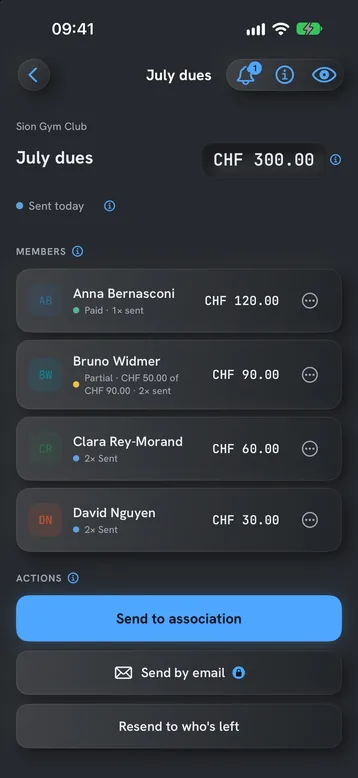
- The rent by m²A total divided by the share of each member. Here, the m² of each room.
- Ancillary costs and the settlementEach one is an expense report, with its lines. You send by year or by month; after the 1st send, the lines are locked.
- One reference per person and per sendSCOR with a regular IBAN; QRR with a QR-IBAN. It follows the Swiss Payment Standards (IG v2.3).
- From your emailThe app sends from your account, Gmail or another provider. Nothing goes out without you, unless you turn on automatic sending (Pro).
- Flatmates don't need the appThey pay the PDF in e-banking, like any QR-bill.
- The data stays on the iPhoneNo account. The app does not talk to your bank: you mark who has paid.
How to make a QR-bill, field by field, is in the guide Create a QR-bill.
Free for one association with up to two members and three active expense reports, no time limit. You can try Pro free for 14 days; then you choose weekly, yearly or a one-time payment, for life. The price is in the App Store.

Download QR Quota for iPhone. One QR-bill per person, each with its own reference, sent from your own email. Free to start, no account.

Frequently asked questions
How much can the rent deposit be for a room in a flatshare?
For a home, at most three months' rent, placed in a bank in an account in the tenant's name (art. 257e CO). Between flatmates, each person hands their share to whoever signed the lease, and you write down how much each person put in.
Who is liable for the rent in a flatshare in Switzerland?
It depends on who signed. Co-tenants are usually each liable for the whole rent, if the lease says so (art. 143 CO): the landlord can claim everything from any one of them (art. 144 CO). Between them, the share is equal unless agreed otherwise (art. 148 CO).
Can I sublet a room without telling the landlord?
No: the tenant needs the landlord's consent (art. 262 CO). The landlord can only refuse if they are not told the terms, if the terms are abusive compared with the main lease, or if the sublet causes them major inconvenience.
How do you split the rent of a flatshare by room size?
The law does not impose a method. Many flatshares split one equal part for the shared spaces and the rest by the m² of each room. It is an agreement between flatmates; without one, the share is equal (art. 148 CO).
Can I ask to see the proofs of the ancillary costs?
Yes: the tenant may inspect the supporting documents (art. 257b CO). Ancillary costs are only paid separately if the lease specifically provides for it (art. 257a CO).
How much notice do I need to leave a flatshare in Switzerland?
If you are on the lease, notice for a home is 3 months, to the termination date provided locally (art. 266c CO), and leaving needs the landlord and the other tenants. If you are a subtenant, your contract with the main tenant applies.
About this guide. Informational content. Not financial, tax or legal advice: what applies to your flat are your lease, your contract with the main tenant, if there is one, and what you agreed with your flatmates. The examples and numbers are invented. The article numbers cited are from the Swiss Code of Obligations (CO); each one links to the official text on Fedlex, in an unofficial English translation. This guide may contain errors or be out of date: always check the official sources. Updated in October 2026.
Sources (7)
- Fedlex: Code of Obligations, articles 143 to 148 (joint liability), unofficial English translation
- Fedlex: Code of Obligations, article 253 and following (the lease), unofficial English translation
- Fedlex: Code of Obligations, articles 257a to 257c (ancillary costs and rent), unofficial English translation
- Fedlex: Code of Obligations, article 257e (the rent deposit), unofficial English translation
- Fedlex: Code of Obligations, article 262 (subletting), unofficial English translation
- Fedlex: Code of Obligations, article 266c (notice for a home), unofficial English translation
- Fedlex: Obligationenrecht (OR), article 253 and following (the lease), in German (the official text)